



Executive Turnover Toolkit
Executive transitions test the strength of the leadership system. This toolkit helps senior leaders stabilize the business, protect momentum, and lead with clarity whether they are stepping into a new role or navigating the disruption created by another leader’s departure.

Why Executive Transitions Matter
Executive turnover is more than a staffing change.
When a senior leader steps into a new role or exits the organization, the effects move quickly through the system. Priorities can become unclear. Decision-making can slow. Teams may start filling the silence with assumptions. Remaining leaders often absorb more work before the organization has fully adjusted.
The first few months matter.
Handled well, an executive transition can create stability, strengthen leadership capacity, and clarify what the business needs next. Handled reactively, it can magnify disruption and drain energy from the people expected to keep performance moving.
This toolkit is designed for two realities:
- You are stepping into a new executive role.
- You are leading through the departure or transition of another senior leader.
In either case, the goal is the same: create clarity early, steady the culture, and use the transition as an opportunity to strengthen the leadership system.
A new executive role brings a narrow window of opportunity. In the first few months, people are watching how you listen, what you prioritize, how you make sense of the business, and what kind of leadership presence you bring into the system.
The goal is to learn the enterprise with discipline, build trust intentionally, and create enough clarity that your leadership can take hold without unnecessary disruption.
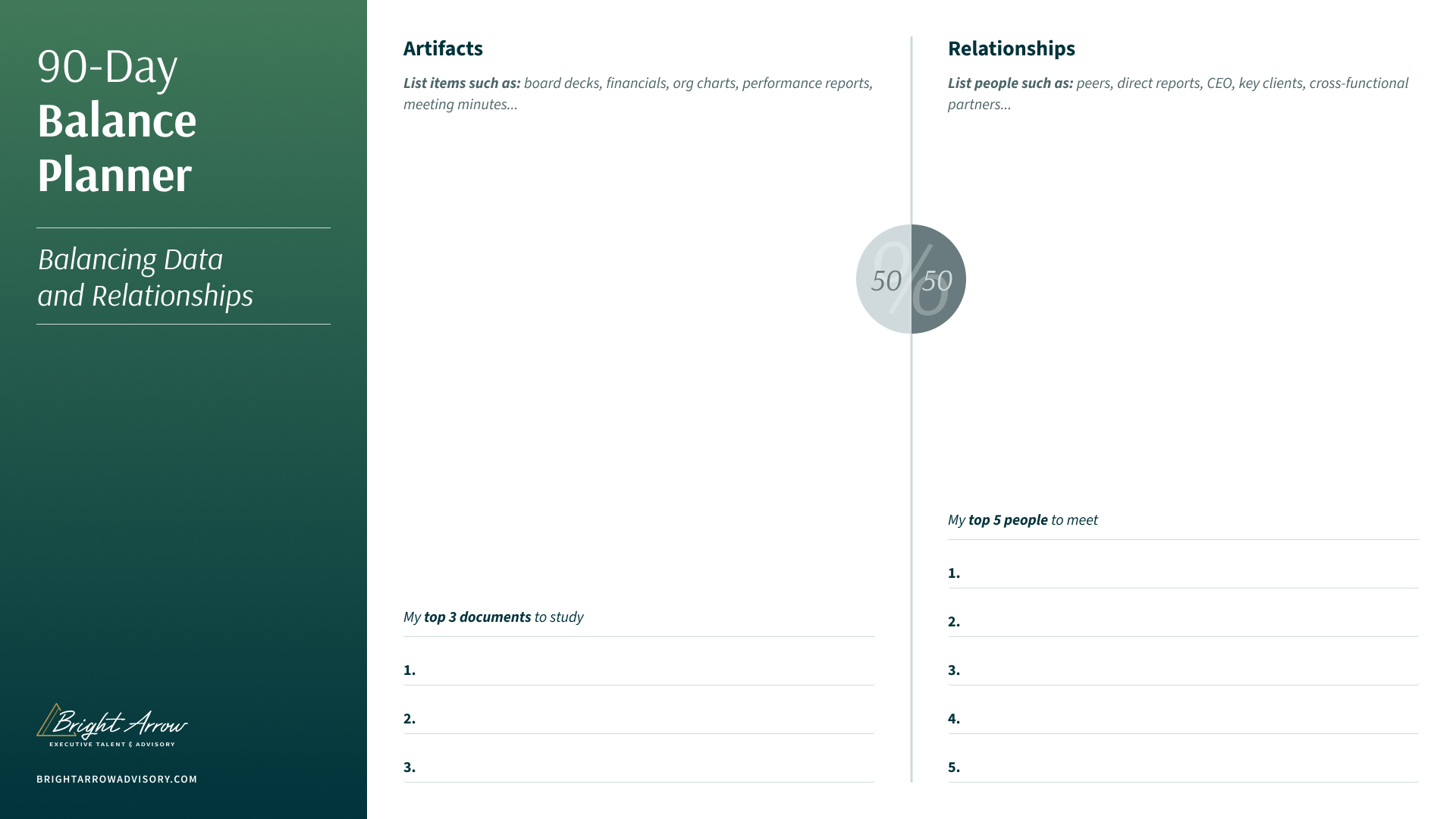
1. Balance Your First 90 Days
Split your onboarding between artifacts and relationships. You need both to understand the business accurately.
50% Artifacts:
Review the materials that reveal how the organization works on paper, including:
- Board decks
- Financials
- Organizational charts
- Performance reports
- Strategy documents
- Meeting minutes
- Customer or stakeholder data
50% Relationships:
Spend equal time understanding how the organization works through people. Meet with:
- CEO and senior sponsors
- Executive peers
- Direct reports
- Cross-functional partners
- Key stakeholders
- Clients or customers, if applicable
Use these conversations to listen for patterns, expectations, tensions, and opportunities. Share enough of yourself to build connection, not so much that you become the center of the conversation
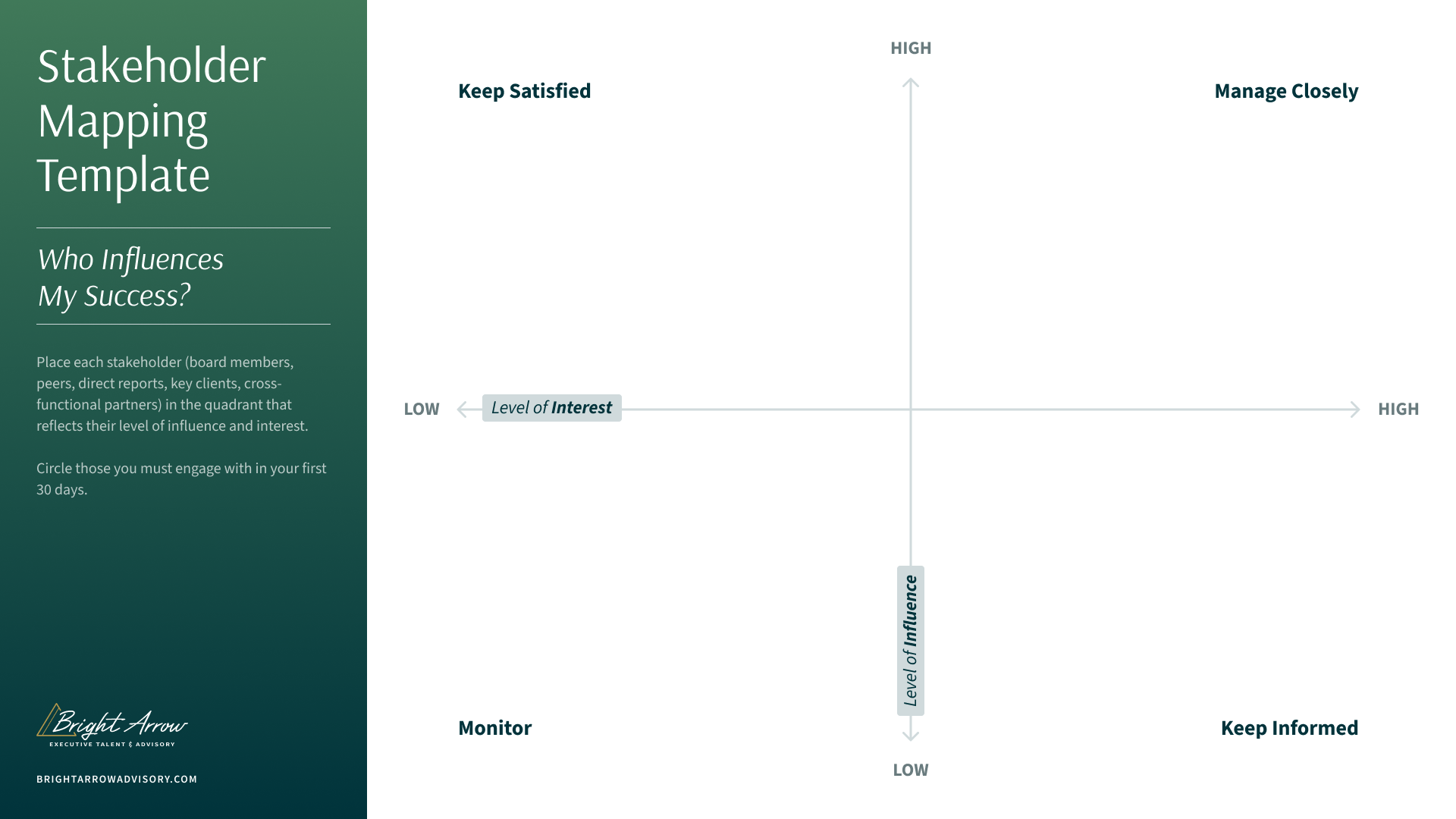
2. Map Your Stakeholders
Work with your CEO or senior sponsor to understand who matters most inside and outside the organization.
A strong stakeholder map should clarify:
- Who has influence
- Who owns critical decisions
- Who needs early trust
- Where expectations may differ
- Where support or resistance may emerge
- Which relationships require immediate attention
Do not assume the formal org chart tells the whole story. Influence often lives in history, credibility, expertise, customer relationships, informal trust, and proximity to key decisions.
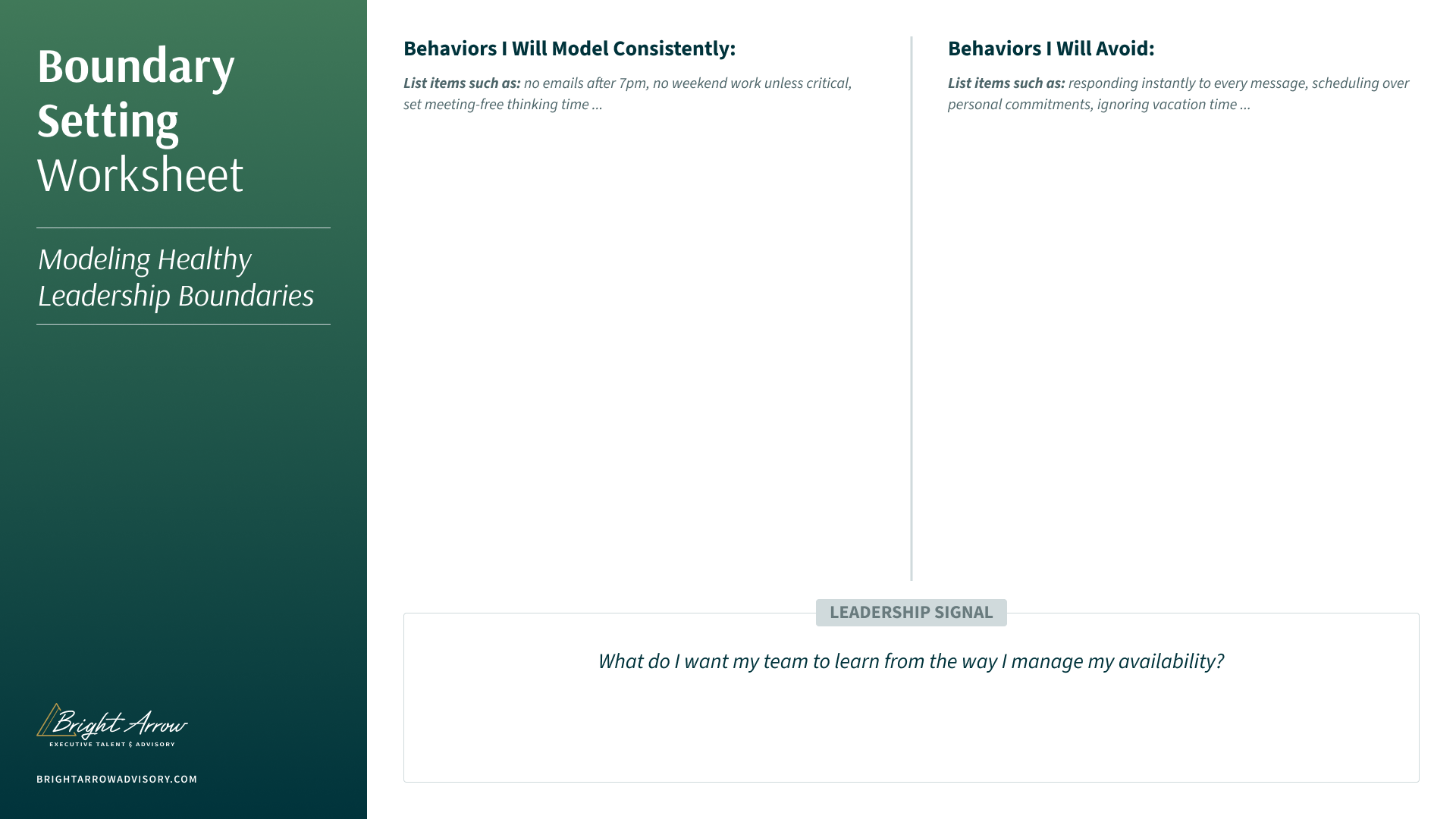
3. Set Boundaries Early
Your availability sends a cultural signal.
If you begin by being constantly accessible, always responsive, and willing to absorb every escalation, the organization will learn that your leadership model depends on overextension.
That expectation becomes difficult to reverse.
Set boundaries early and clearly. This does not mean becoming unavailable. It means modeling the kind of sustainable executive leadership you want others to practice.
Clarify:
- How you prefer to receive information
- When issues should be escalated
- What requires immediate attention
- How decisions should move without you
- When you are available for direct access
- What rhythms will support sustainable execution
4. Use Your Fresh Perspective
For the first three months, you have a valuable advantage: objectivity.
You can see patterns others may have normalized. You can ask questions people inside the system have stopped asking. You can notice inconsistencies between stated priorities and daily behavior.
Use that perspective carefully.
Operate like a strategic observer before becoming a decisive operator. Ask thoughtful questions. Listen for repeated themes. Name early observations with humility. Offer feedback while you are still seeing the organization with fresh eyes.
This window closes quickly. Once you become fully embedded in the system, some patterns will become harder to see.
Executive Shift:
Your early value is not only what you know. It is what you can still see clearly before the system shapes your assumptions.
When another executive leaves or changes roles, the organization does not simply redistribute work. It redistributes uncertainty.
Remaining leaders may inherit more responsibility, teams may wonder what the change means, and priorities may become less clear before a formal plan is in place.
Your role is to stabilize without pretending nothing has changed.
1. Acknowledge the Ripple Effect
Executive departures create immediate system strain.
Even when the transition is planned, positive, or necessary, people feel the absence. Decisions may slow. Work may pile up. Teams may wonder who owns what. Remaining executives may absorb responsibilities before capacity has been redesigned.
Name the ripple effect directly.
That may include:
- Additional workload for remaining leaders
- Temporary ambiguity around decision rights
- Emotional reactions from teams
- Increased risk of burnout
- Speculation about strategy or stability
- Pressure on interim leaders
Acknowledging the strain does not create instability. It gives people confidence that leadership sees reality clearly.
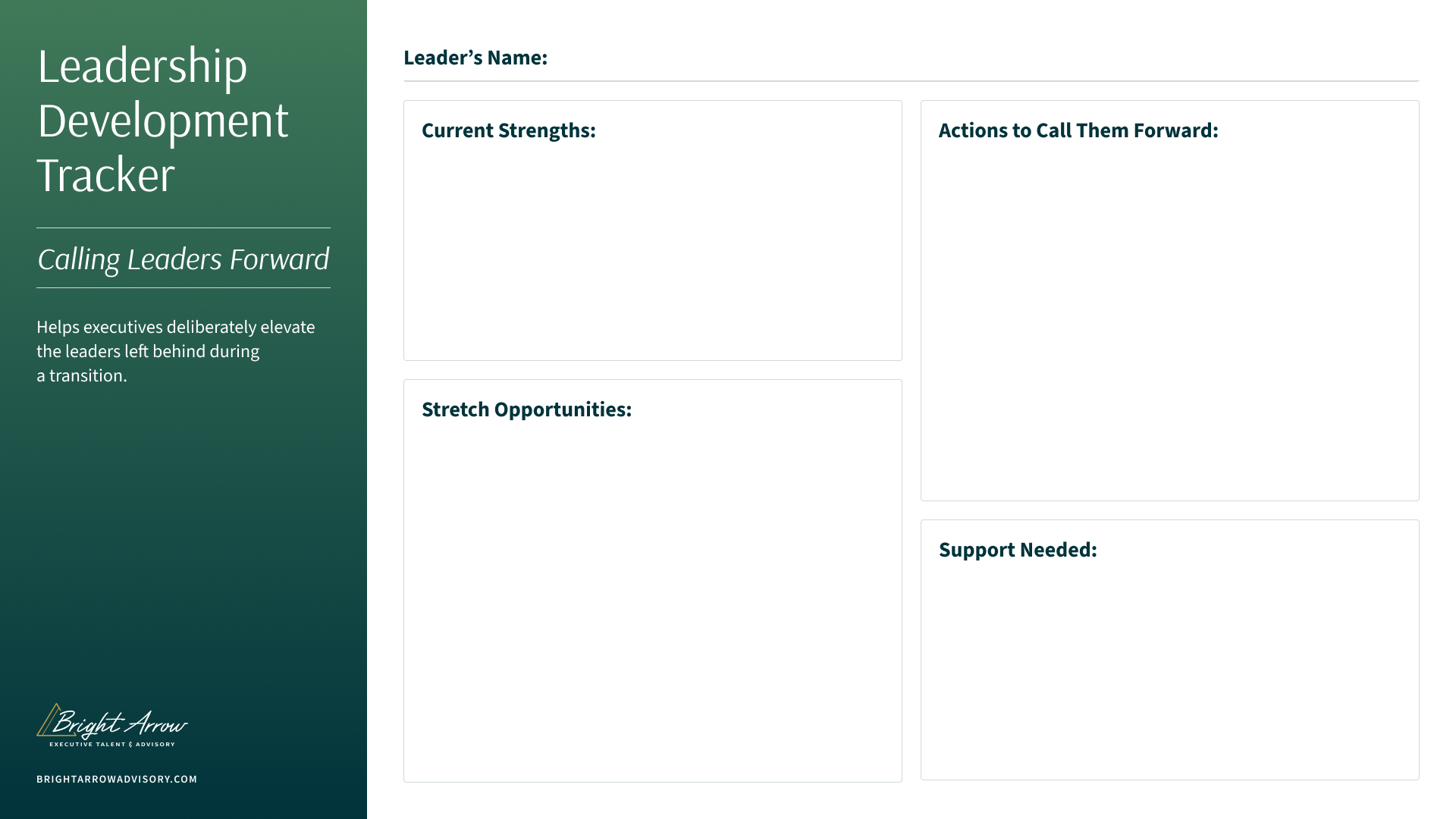
2. Call Leaders Forward
A transition can become a development moment for the leaders who remain.
Rather than allowing the organization to simply wait for a replacement, use the moment to call capable leaders forward. Invite them to think more broadly, own their functions with greater maturity, and contribute to enterprise stability.
This can accelerate leadership readiness while giving the organization needed capacity.
Ask leaders to:
- Clarify what they can own now
- Identify where they need support
- Think beyond their immediate function
- Communicate more proactively
- Step into cross-functional problem-solving
- Model calm and accountability for their teams
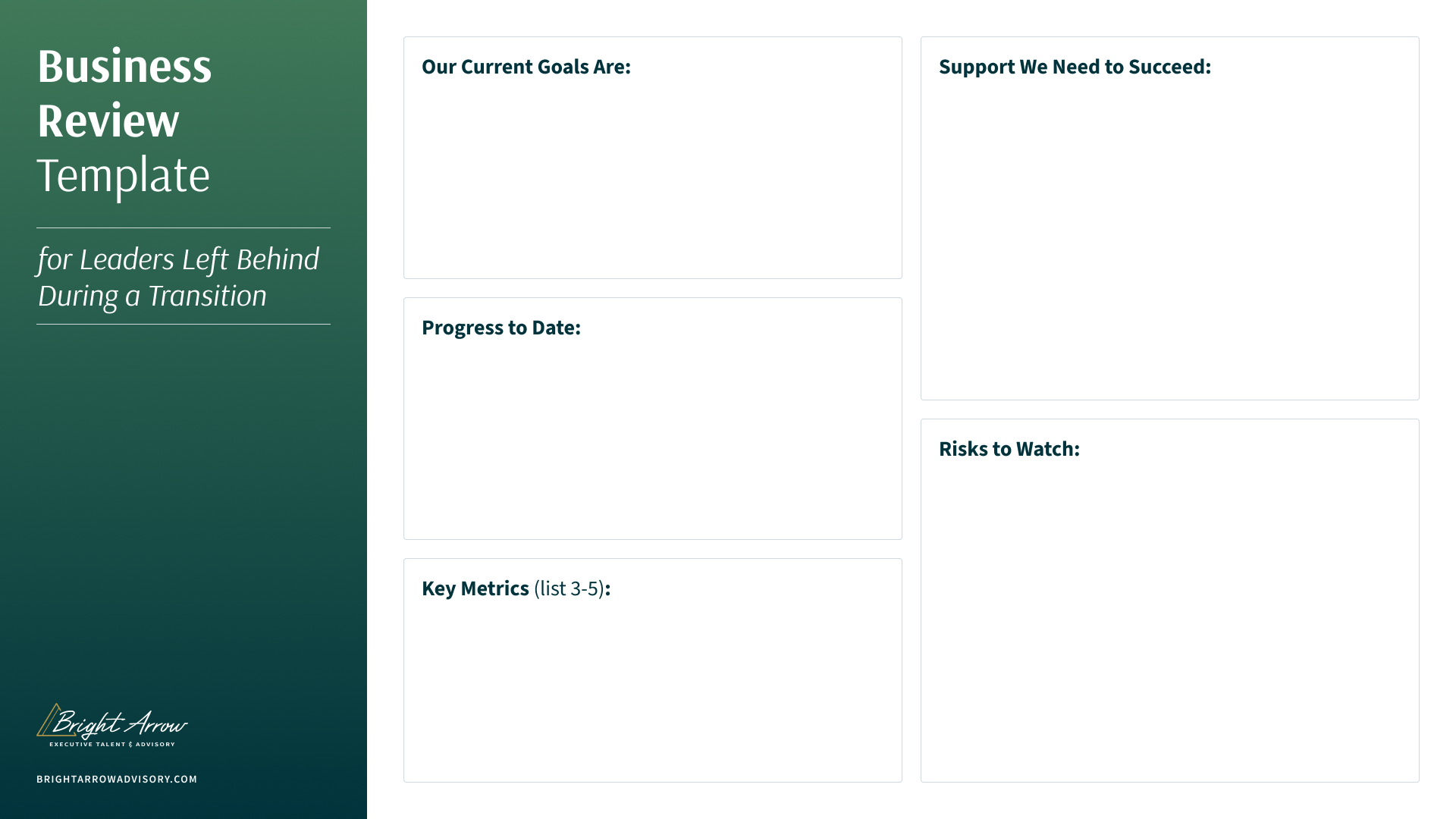
3. Create a Business Review for Interim Leaders
When a leader is covering a vacant role or absorbing additional scope, clarity is a form of relief.
Prepare a concise business review that helps them understand what matters most and where attention is needed.
Include:
- Current priorities and goals
- Progress made so far
- Key risks or unresolved issues
- Important stakeholders
- Upcoming decisions
- What support is needed to succeed
- What should not be lost during the transition
This type of handoff reduces ambiguity and reassures the team that the business will continue moving with discipline.
4. Steady the Culture
Transitions create space for speculation.
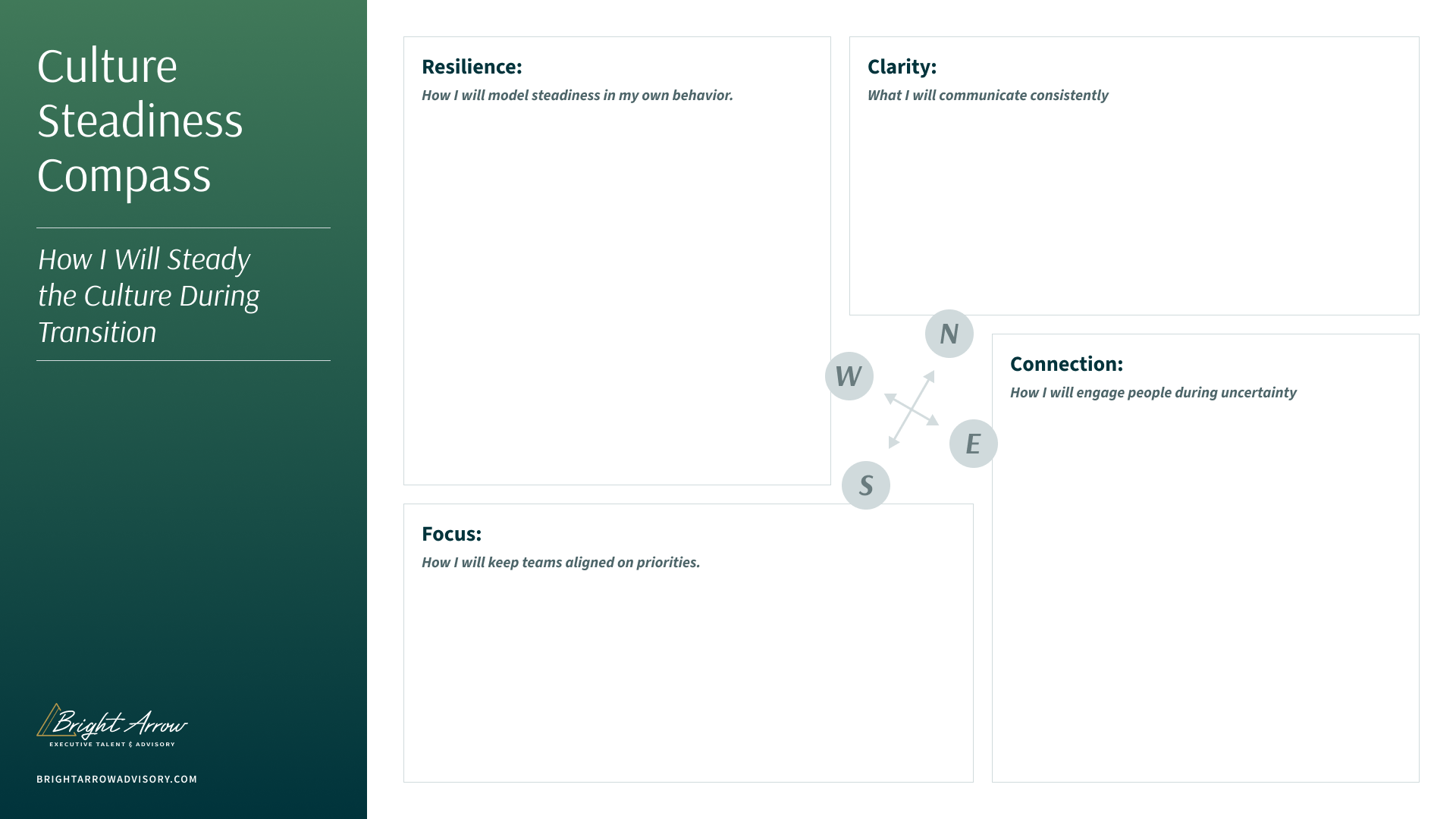
People watch what leaders say, what they avoid, how they behave, and whether the organization appears focused or distracted. In the absence of clear communication, people will often fill the gap themselves.
Steady the culture by communicating with consistency and composure.
That means:
- Naming what is known
- Being honest about what is still being decided
- Repeating priorities clearly
- Reinforcing where the business remains stable
- Reducing unnecessary drama
- Modeling focus, resilience, and trust
- Addressing rumors before they become the narrative
Your behavior matters as much as your message. Teams do not only listen to leadership during transitions. They study it.
Explore this related Bright Arrow resource:
How to Navigate the Tough Tides of Executive Turnover
A resource for leaders working to maintain clarity, continuity, and trust through senior leadership transitions.
Executive transitions are inevitable. They will create disruption, but they do not have to derail the organization.
The difference is leadership discipline.
When executives prepare intentionally, communicate clearly, call leaders forward, and set the tone early, transition can become more than a period of risk. It can become a moment that strengthens the leadership system.
The measure of leadership is not only visible in stable seasons.
It is often revealed most clearly when the structure shifts, the path is uncertain, and people are looking for steadiness.
Executive Shift:
Transitions test leadership capacity. They can also build it.