


Team Development In Action
Team development does not have to compete with the work.
This guide gives executives practical tools for building clarity, accountability, decision quality, feedback, and learning into the operating rhythm of the team so development happens while performance expectations remain in motion.

Introduction
Strong teams are not developed only in offsites, workshops, or formal training programs.
They develop in the way priorities are communicated, decisions are made, feedback is exchanged, problems are solved, and meetings are run. The most effective leaders build development into the flow of work so the team improves while still delivering on operational priorities.
This guide offers seven practical leadership strategies designed to strengthen team performance without pulling people away from the work that matters. Use these tools to create clearer expectations, build stronger accountability, improve collaboration, and help talented team members grow through real business challenges.
Many meetings are dominated by updates on work already completed. That may create awareness, but it does not always create movement.
Effective team development begins with clarity. People need to understand what matters most, what needs to happen next, who owns the work, and how the work connects to larger team or enterprise priorities.
A leader’s job is not simply to share priorities once. It is to reinforce them through agendas, check-ins, decisions, and follow-up.
Your team should be clear on:
- What the goal or priority is
- What matters most right now
- What needs to happen next
- Who owns the next action
- When the work must be completed
- How the work connects to broader team or business outcomes
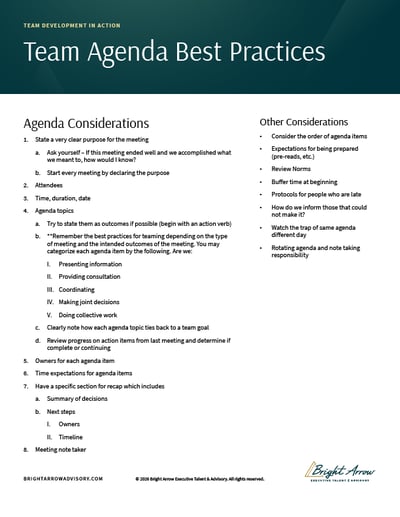
Whether you are leading a one-on-one or a group meeting, use agendas that tie directly back to team goals. State each agenda topic as an outcome, begin with an action verb, and make clear how the item connects to a priority.
Assign an owner and time expectation to each agenda item so the team stays focused, accountable, and aligned.
Teams lose time and trust when decision rights are unclear.
People may duplicate effort, delay action, escalate unnecessarily, or assume they have authority they do not actually hold. Clear decision-making frameworks help teams move faster with less confusion.
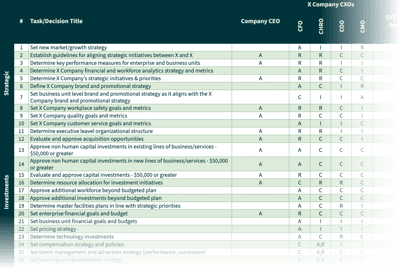
The RACI model is one practical tool for clarifying stakeholder roles in a decision or project.
Responsible
These are the people responsible for implementing the work and moving the task forward.
Accountable
This is the person ultimately accountable for the decision, outcome, or final approval.
Consulted
These are the people who should provide input before the decision is made.
Informed
These are the people who need to be updated once the decision has been made.
Using a framework like RACI reduces ambiguity and helps teams understand how to contribute without slowing the work down.

Autonomy is not the absence of accountability. It is the ability to make decisions within clear expectations.
Leaders strengthen team performance when they give people enough authority to manage their work, solve problems in real time, and adjust without waiting for constant approval. This reduces delays, builds confidence, and helps team members develop better judgment.
Flexibility also matters. When people have room to manage work preferences, schedules, and location where appropriate, they are often better able to focus on outcomes.
The leader’s role is to set clear expectations and remain available for support or course correction when needed.
Autonomy works best when team members understand:
- The outcome they are responsible for
- The decisions they can make independently
- When they should escalate
- What deadlines or quality standards must be met
- How their work connects to larger priorities
When team members know they are trusted to shift gears, reprioritize, and solve problems responsibly, they become more engaged in the work and more capable as leaders.
Strong teams do not only solve problems. They know how to define them.
Leaders can strengthen problem-solving by helping team members slow down enough to clarify what is actually happening before moving to solutions. Without that discipline, teams often solve the visible symptom instead of the root issue.
A practical problem-solving rhythm includes:
- Define the problem clearly.
- Confirm who is affected and how.
- Identify the facts already known.
- Separate assumptions from evidence.
- Generate multiple possible solutions.
- Test the risks, trade-offs, and implications of each option.
- Decide on a path forward.
- Review what was learned after implementation.
Your job as a leader is not to provide every answer. It is to ask better questions, test assumptions, invite multiple perspectives, and keep the team grounded in facts.
Encourage people to remain open to different viewpoints while evaluating possible solutions with discipline. This builds critical thinking and reduces bias.
Executive Shift:
A team that can define problems well can solve them with less escalation and more confidence.
Feedback should not be reserved for annual reviews or moments when something has gone wrong.
Strong teams make feedback part of their operating rhythm. Specific, timely, and actionable feedback helps reinforce priorities, support skill development, recognize progress, and improve performance before small issues become larger patterns.
Feedback should move in multiple directions:
- Leader to team member
- Team member to leader
- Peer to peer
- Team to team
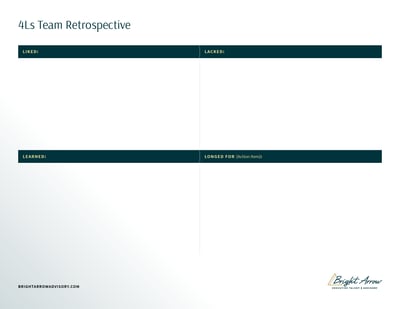
At the end of large projects or each quarter, run a team pulse-check using the 4Ls:
- Like: What worked well?
- Lack: What was missing?
- Learn: What did we learn?
- Long For: What do we want or need going forward?
In one-on-one meetings, invite feedback by asking:
- “How are you experiencing me as a leader through this project?”
- “How can I better support your development through this priority?”
- “What do you need more clarity on?”
- “Where am I helping, and where might I be slowing you down?”
The goal is not feedback for its own sake. The goal is to create a team environment where learning happens continuously and accountability feels normal.

Teams cannot perform at their best without trust.
A supportive environment does not mean avoiding hard conversations or lowering expectations. It means creating the conditions where people can communicate openly, ask for help, share knowledge, and work through challenges without unnecessary fear or isolation.
Leaders create this environment through consistent behavior.
That includes:
- Facilitating open communication
- Encouraging knowledge sharing across locations and work styles
- Making space for remote and hybrid team members to contribute fully
- Being approachable when challenges arise
- Holding regular check-ins and one-on-ones
- Listening actively rather than rushing to solve
- Observing nonverbal signals and shifts in engagement
- Recognizing where collaboration is strong and where it needs support
Trust is not built only through team-building activities. It is built through the work itself: making commitments, following through, asking for input, naming tension, solving problems, and learning together.
Executive Shift:
Supportive environments are not soft. They are where accountability can be sustained without fear-driven behavior.

A strong learning culture helps teams adapt, improve, and stay curious while the work continues.
Leaders can create that culture by encouraging team members to test ideas, ask better questions, and treat real work as a development opportunity. This is especially important when the team is navigating change, new priorities, or complex problems.
Use action-oriented language in team agendas and project plans. For example:
- Pilot
- Test
- Research
- Explore
- Attempt
- Evaluate
- Refine
- Apply
Experiential learning is especially valuable because people build skill through application, not theory alone.
A simple experiential learning cycle includes:
- Concrete Experience: The team tries something in real work.
- Reflection and Observation: The team examines what happened.
- Conceptualization: The team identifies the lesson or principle.
- Active Experimentation: The team applies the insight in a new context.
This kind of learning builds judgment, not just knowledge.
Executive Shift:
The best development happens when leaders turn real work into a learning environment.
Team development requires ongoing attention from leaders.
It is not a separate initiative to complete and move past. It is built through repeated habits: clearer priorities, better decisions, stronger feedback, healthier problem-solving, more trust, and a steady commitment to learning while the work is happening.
These seven strategies are designed to help leaders maintain the balance between developing the team and protecting focus on key operational priorities.
Use them when you need to:
- Clarify what matters most
- Improve decision speed
- Build ownership and autonomy
- Strengthen problem-solving
- Create healthier feedback loops
- Build trust and support
- Reinforce continuous learning
When team development is embedded into daily work, it can improve team dynamics, accountability, engagement, and business outcomes without pulling people away from performance.
Bright Arrow’s Leadership Team Coaching is designed to develop leaders and solve performance challenges in real time. We help teams strengthen the way they communicate, decide, collaborate, and execute while the actual work is underway.
Executive Shift:
Team development is strongest when it becomes part of the operating rhythm, not an interruption to it.