


Scenario Planning Playbook
Uncertainty does not have to push your executive team into reactive decision-making. This playbook helps senior leaders pressure-test possible futures, align around response plans, and create the clarity needed to move decisively when conditions change.

Scenario Planning Helps Ensure Alignment
Scenario planning helps executive teams prepare for uncertainty before it becomes urgent.
It gives leaders a structured way to examine plausible disruptions, stretch their thinking beyond the current plan, and define how the organization may need to respond under different conditions.
The value is not prediction. The value is preparedness.
When volatility hits, the last thing an organization needs is each executive interpreting the moment independently. Scenario planning brings the senior team into a shared conversation about what could happen, what signals matter, what decisions may be required, and how the team will stay aligned under pressure.
Why It Matters:
- Scenario planning reduces reactive decision-making.
- It helps leaders name risks that may otherwise stay unspoken.
- It creates a safer space for the executive team to examine uncomfortable possibilities.
- It clarifies which responses should be activated, paused, or held until specific triggers appear.
- It helps the broader organization see a more unified, composed leadership team when uncertainty increases.
Executive Team Only — Behind Closed Doors:
This work belongs first inside the executive room. It is where leaders can surface the difficult possibilities, test assumptions, and build contingency plans without creating unnecessary noise across the organization.
Some scenarios may require immediate action. For example, if the team sees labor supply risk ahead, it may choose to accelerate talent acquisition or strengthen succession coverage now. Other scenarios may simply be documented, monitored, and held until the right trigger appears.
The goal is not to alarm the organization. The goal is to ensure the executive team is ready before the organization needs it to be.
Scenario planning should not be treated as a one-time exercise during a crisis. It should become a repeatable leadership discipline the executive team can return to when conditions shift.
Use the process below to create structure, ownership, and decision clarity.
Step 1: Define Objectives & Scope
Start by clarifying what kind of uncertainty you are planning for and how far into the future the team should look.
Questions to Consider:
- What external disruptions are most likely to affect the business?
- Where could economic shifts, regulation, technology, market changes, or customer behavior create pressure?
- What internal vulnerabilities could amplify those risks?
- Where are we most dependent on specific talent, systems, vendors, or operating assumptions?
Executive Shift:
A clear scope keeps scenario planning focused. Without it, the conversation can become too broad to be useful.
Step 2: Identify Critical Uncertainties
Name the two or three unknowns that could significantly affect the business.
These should be issues with both high uncertainty and high impact. They may include:
- Global supply chain disruption
- AI adoption or regulation
- Labor availability
- Customer demand shifts
- Capital constraints
- Competitive pressure
- Regulatory change
- Leadership or succession risk
Executive Shift:
The most useful scenarios are built around the uncertainties that could materially change the way the business must operate.
Step 3: Develop 3-5 Plausible Scenarios
Use the critical uncertainties to construct a small set of plausible futures.
Avoid creating fantasy scenarios or overly precise predictions. The goal is to stretch executive thinking while staying grounded in business reality.
Example Scenarios:
- Scenario A: AI Hyper-Acceleration Rapid adoption unlocks new efficiencies but requires significant workforce reskilling.
- Scenario B: Regulatory Squeeze Compliance costs rise quickly, slowing innovation and increasing operating complexity.
- Scenario C: Talent Crunch Skilled labor becomes scarce, forcing new automation investments and sharper succession planning.
Executive Shift:
A good scenario should be specific enough to test your strategy and realistic enough to influence decision-making.
Step 4: Stress-Test Strategy Against Each Scenario
Once the scenarios are defined, examine how your current strategy would hold up under each one.
Questions to Consider:
- How does our current strategy perform in this future?
- Where would we need to pivot?
- What would become more important?
- What would become less relevant?
- Which initiatives would accelerate?
- Which initiatives would need to pause?
- Where would our leadership team be most strained?
This step helps the executive team identify the initiatives, investments, decisions, or communication shifts that may be triggered under different conditions.
Executive Shift:
Stress-testing does not weaken strategy. It strengthens the team’s ability to adapt without losing alignment.
Step 5: Assign Ownership
Each scenario should have a clear owner.
That owner is not responsible for solving the scenario alone. They are responsible for monitoring related indicators, tracking changes, and alerting the executive team when the scenario becomes more likely or requires action.
Scenario Owners Should Monitor:
- Early warning signals
- Relevant market or internal indicators
- Trigger points
- Decision timing
- Cross-functional implications
- Recommended next steps
Executive Shift:
Without ownership, scenario planning becomes an interesting conversation instead of a usable leadership tool.
Step 6: Document Decisions & Decision Logic
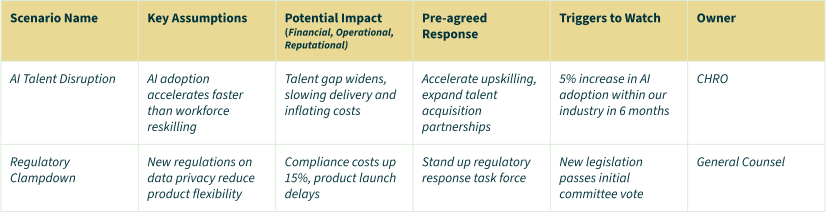
Create a shared Scenario Planning Workbook for the executive team.
This document should capture the thinking behind each scenario so the team does not reopen the same debates every time volatility appears.
The Workbook Should Include:
- Scenario narrative
- Core assumptions
- Early warning indicators
- Activation triggers
- Pre-agreed responses
- Potential initiatives or investments
- Messaging implications
- Decision owners
- Review cadence
Executive Shift:
Documentation preserves leadership clarity when pressure rises.

After the executive team completes scenario planning behind closed doors, the next discipline is communication.
Not every scenario needs to be shared broadly. Some planning should remain confidential until a trigger appears or a decision is made. But the broader workforce does need to see a unified executive team that is calm, aligned, and clear about current priorities.
The goal is to communicate enough to create confidence without overwhelming people with uncertainty.
Clarify What Matters:
- What enterprise priorities remain steady?
- What key initiatives may emerge if conditions change?
- What work may need to pause or move into a backlog?
- Who has decision-making authority if a scenario is triggered?
- How will employees know when priorities shift?
- What should teams focus on now?
When employees understand how leadership is thinking, they are less likely to fill the silence with speculation.
Executive Shift:
In ambiguous conditions, clarity does not require full certainty. It requires disciplined communication.

Scenario planning can be difficult for executive teams to facilitate on their own.
The same dynamics that affect everyday leadership can show up in the planning process: functional bias, unspoken risk, CEO dependence, optimism bias, conflict avoidance, or pressure to move too quickly to the answer.
An external facilitator can help the team slow down enough to think clearly, surface the right tensions, and build alignment around what the organization may need to do next.
Bright Arrow supports executive and leadership teams through high-stakes conversations that require clarity, trust, and disciplined decision-making. We help leaders examine uncertainty, strengthen alignment, and return to the field with a clearer path forward.
Executive Shift:
Scenario planning is not only a strategy exercise. It is a leadership alignment exercise.