Today’s executive teams are navigating constant disruption, evolving strategies, and increasing pressure to deliver results in real time. In that environment, succession planning often gets pushed aside or reduced to a periodic HR exercise. But when leadership transitions happen without preparation, the consequences are immediate and far-reaching — loss of momentum, fractured alignment, and in some cases, years of instability.
That’s why succession planning, when done well, is not a checklist or a compliance activity. It is a leadership discipline.
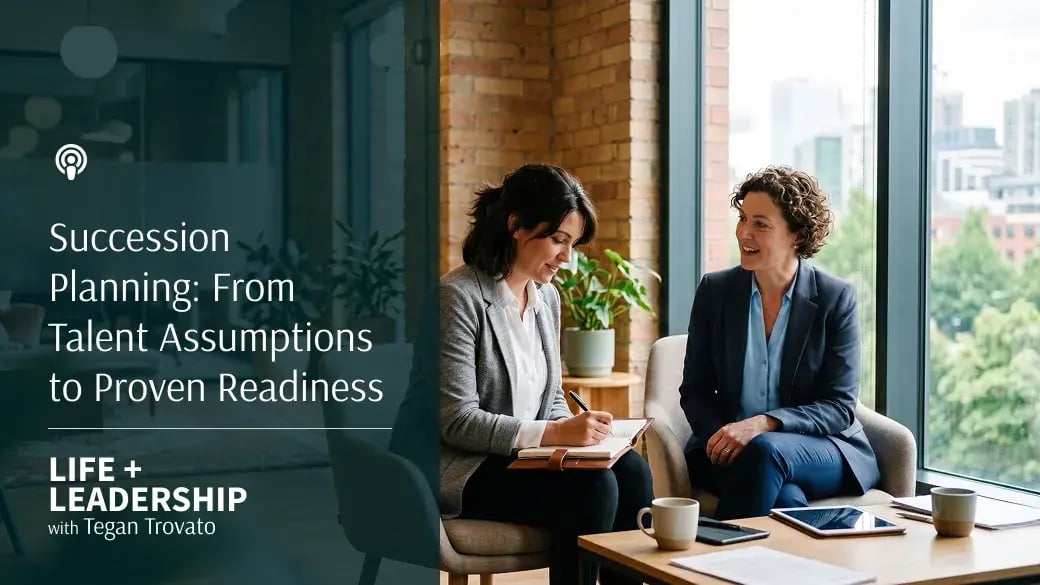
In this episode of Life + Leadership, we unpack what succession planning really requires of executive teams and boards. The conversation moves beyond surface-level planning into the deeper work of building leadership continuity, developing future-ready talent, and protecting the long-term health of the organization.
This is not about filling roles. It is about building a system that ensures the business can continue to perform, evolve, and lead — no matter who is in the seat.
Succession Planning Is Not an HR Exercise
One of the most important reframes in this conversation is ownership. Succession planning cannot sit solely within HR, nor can it be something that gets “served up” to the executive team once a year. It is a shared responsibility.
When succession planning is treated as a functional process, it loses its connection to strategy. But when it is owned by the CEO, the executive team, and, at the highest level, the board, it becomes something entirely different — a discipline that actively protects the future of the business.
This shift matters because leadership transitions impact every part of the organization. When an executive leaves, the ripple effects are immediate. Teams lose clarity, decision-making slows, and strategic priorities can drift. Succession planning, when embedded into how a leadership team operates, ensures that those moments do not destabilize the organization.
Defining the Future, Not Replacing the Present
A common mistake in succession planning is anchoring too heavily in the current state of the business. Organizations often define roles based on what exists today or based on the person currently in the seat. But effective succession planning looks forward. Executive success profiles should reflect where the business is going in the next three to five years, not just where it is today. That means identifying the experiences, capabilities, and leadership behaviors that will be required in the future — even if those expectations are different from what the role demands right now.
This forces executive teams into a more strategic conversation. What will this business need from its leaders as it evolves? What capabilities will become critical? Where are we underdeveloped? When this work is done well, it not only clarifies succession planning but also sharpens the organization’s overall leadership strategy.
Creating Objectivity in Talent Decisions
Another critical layer of succession planning is alignment around what “great” actually looks like. Without a shared competency model, talent conversations quickly become subjective. Leaders may use the same language — strategic thinking, executive presence, leadership maturity — but mean entirely different things. That misalignment creates confusion in development, inconsistency in evaluation, and frustration for the leaders being assessed.
A clearly defined competency model creates a common language. It allows executive teams to assess talent more objectively and ensures that development efforts are aligned to a consistent standard.
This matters not just for fairness, but for retention. Too often, leaders believe they are being developed for future roles, only to discover later that they lacked key experiences the organization never clearly defined. By the time that gap is visible, the organization has lost time and, potentially, the leader.
“When succession planning is treated as a functional process, it loses its connection to strategy. But when it is owned by the CEO, the executive team, and, at the highest level, the board, it becomes something entirely different — a discipline that actively protects the future of the business.”
Assessing Talent Requires a Holistic View
Once roles and competencies are defined, organizations can begin to assess successor candidates in a meaningful way. Strong succession planning does not rely on a single data point. It requires a multi-dimensional view of each leader, including performance, potential, and readiness.
Performance tells us how someone is operating today. Potential gives insight into how they might grow, often through indicators like learning agility and self-awareness. Readiness helps organizations understand when a leader could realistically step into a role — now, in a few years, or further down the line.
The most effective organizations combine multiple inputs to form this view. Interviews, 360 feedback, and structured assessments each provide different insights. Together, they create a more complete picture of the leader.
This approach also helps mitigate bias. No single perspective defines a leader’s readiness. Instead, organizations use a blend of internal and external data to make more informed decisions about development and succession.
Development Is Where Succession Planning Becomes Real
Identifying talent is only the beginning. The true value of succession planning is realized through development. And this is often where organizations struggle. Development requires intentionality, time, and prioritization — all things that can feel scarce for executive teams. But without it, succession planning becomes theoretical. The most effective development happens through real business exposure. Emerging leaders need access to complex, high-stakes situations. They need to see how decisions are made under pressure, how trade-offs are evaluated, and how strategy is executed in uncertain conditions. This might look like expanded P&L exposure, rotational roles across the business, or participation in cross-functional initiatives where leaders are asked to operate outside their immediate scope.
Board exposure is another critical component. Too often, leaders are introduced to the board only in the months leading up to a transition. That approach creates pressure, not readiness. Meaningful exposure requires time — enough to see a leader operate across business cycles and to support their growth in that environment. Development is not linear, and it is not identical for every leader. But it must be deliberate. Without it, succession planning cannot fulfill its purpose.
Managing Risk Before It Becomes Reality
Succession planning is also a form of risk management. Organizations must look beyond who could fill a role and consider what could go wrong. Where are we overly reliant on a single individual? Which leaders may be at risk of leaving? Where are there gaps in the pipeline beneath the executive level?
These questions require honesty.
Sometimes, talent vulnerabilities surface deeper organizational issues. A flight risk may not just be about the individual; it could reflect another unresolved issue on the team. A lack of readiness in a key function may reveal that development has not been prioritized. Addressing these risks early allows organizations to act before vulnerabilities become disruptions.
Looking Outside the Organization
One of the more underutilized practices in succession planning is maintaining awareness of external talent. Even when organizations have strong internal candidates, understanding the external market provides valuable perspective. It helps leaders benchmark their talent, identify emerging capabilities, and stay connected to how leadership is evolving more broadly. This does not always mean hiring from the outside. In many cases, it strengthens internal development by highlighting what experiences or capabilities internal candidates still need.
Building a Leadership Pipeline, Not a Shortlist
Succession planning cannot be limited to identifying one or two potential replacements for each executive role. It must extend deeper into the organization. Strong succession strategies focus on building a pipeline — identifying feeder roles, developing talent at multiple levels, and creating pathways for leaders to grow into more senior positions over time.
At the CEO level, succession planning becomes a board responsibility. And it is one of the most critical responsibilities they hold. CEO transitions have the potential to reshape an organization’s trajectory. When handled reactively, they can create instability that lasts for years. That is why boards must approach CEO succession with the same level of discipline outlined for executive teams.
At its core, succession planning is not just about preparation. It is about stewardship. When leaders invest in succession planning, they are making a commitment to the future of the organization — to its people, its culture, and its ability to endure beyond any one individual. It becomes a way to build enduring strength.